creative [kree-ey-tiv]: adjective. Synonyms: clever, cool, innovative, inspired, prolific, stimulating.

criticism [krit-uh-siz-uhm]: noun. The act of passing judgment as to the merits of anything.

12 Jul 2010

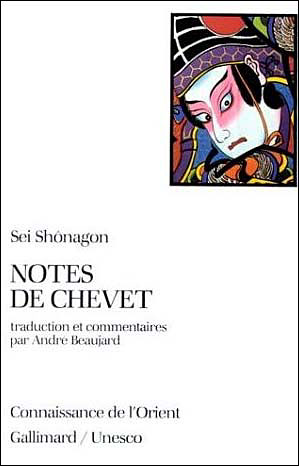
Notes de chevet - Sei Shônagon

I think the English translation of this Japanese book is called The Pillow Book - or at least, so says this blog entry that really made me want to read this book.
Which I did, obviously.
It was interesting; I found it very poetic, snarky at times, definitely classist, and a wonderful plunge into 10th/11th century Japanese aristocracy (without having to personally suffer the consequences of time travel). Furthermore, I enjoyed the random lists that are peppered through the book. I don't know why exactly, but I did.
So this is a book in the UNESCO collection of representative works (Japanese series). Well, if the UNESCO approves, it must be good!
I kid, but really, it was an enjoyable read indeed. There are also 162 sections that divide this 281-pages long book, so if you overdose on this book, it's your own damn fault. Take it easy, take your time, and renew your library checkout so that you don't get slapped a fine.

8 Jul 2010

Okami - That Wii Game

You are Amaterasu, the sun goddess and mother to all the other gods of the land. Your earthly form is that of a white wolf, and you must travel across the land to expand your magical skills in order to defeat your 200-year-old enemy, Orochi, that you defeated 100 years ago but who has managed to survive and reappear.
And then some.
And then some more.
And then EVEN MORE THINGS HAPPEN.
All set to excellent - nay, beyond-excellent - music!

[Spoiler alert, for those who care about such non-plot revelatory gameplay details:]
This game is just so massive, so huge, that at one point I started to doubt that it would have an ending (this is a good thing!). But after more than a dozen boss fights, you get the Final Boss Fight, and after that your story's over, you get some nifty statistics about your journey (I only got one death! And collected 156 demon fangs! And defeated 485 monsters! All on my first play-through!), and... you can start all over again. But you get to keep (almost) all the items (yes, even the weaponry), all the fangs and all the money that you had when you finally defeated the Final Boss. AND you can change your appearance, which does nothing as far as your abilities are concerned, but I personally find the fatty one to be adorable, and so on my second play-though Amaterasu is one fatty fluffy adorable wolfie.
[/Spoiler alert over. You can start reading again now.]


So yes, this game is massive, and can most definitely be a source of several dozens of hours of enjoyment. There are plenty of sidequests you can do:

  • Defeat these monsters on this hit list! And get a reward.
  • Find all the Hidden Beads! And get a reward (supposedly).
  • Feed all of the animals of all the species you can feed! And sometimes get a reward.
  • Restore all of nature/make all the trees bloom! And sometimes get a reward.
  • Find out all the extra stuff you can do with your magical Celestial Brush techniques. And gain skills! (Skills can include battle techniques such as Whirlwind or Double Cherry Bombs)
This game IS rated T for Teen though, due to its reliance on alcoholic drinks (sake! It can help you defeat monsters, it can increase your attack/defense, it can give you magical powers to make the Sacred Tree bloom, apparently). Also, your sidekick Issun can be misogynistic at times, so critical thinking and player discretion is advised. Oh, and boobs and butts are very present in the game (play it, and you'll see what I mean - especially when you'll first meet Rao (jiggles abound), and when you'll first see Sakuya's dress. It has butt cleavage).
There was one rather funny bug in the game, though: during my fight against the last Canine Warrior, Amaterasu's head decided to stick to one point that was pretty far away in the environment. The rest of my character's body moved normally, though, so it essentially became a fight between my canine enemy VS my headless wolf-self. It was pretty funny. Right after the fight I went to a save-point, saved, exited the game and went back in, and everything was back to normal.
Still, I enjoyed this game very much, I think it gives a much better cost-to-hours of entertainment than, say, Zelda did, and I most certainly recommend it. Play this game!
4 Jul 2010

Soulless - Gail Carriger

Vampires (whose social structure resembles that of bees), werewolves, Victorian fashion and mores, mad scientist conspiracies, a dash of steampunk and some really steamy makeout scenes mixed together with a touch of the Mister Darcy Syndrome makes for an interesting and very entertaining novel by Gail Carriger.
This is a great book to read one chapter at a time, since the story is easy to slip in and out of. Plus, since Alexia Tarabotti - the awesome, intelligent, scientifically curious and strong-willed main character - seems to be mildly amnesiac about pretty important plot elements, there are some reminders about the relevant plot points during each chapter. It is, however, pretty hard to put down the book since all the chapter separations seem to occur right in the middle of fascinating, important, or downright steamy scenes.
After the epilogue is over and the story proper is done with, there's this interview of the author in which one answer pretty much sums up everything that's great about this genre-rich novel:
Soulless has such a clever melding of alternate history, romance, and the supernatural. How did you derive the idea for this novel? I knew I wanted to write urban fantasy, and there's one thing I've never been able to understand in the genre: if immortals were mucking about, wouldn't they have been mucking about for a very long time? A speculation arose: what if all those strange and unexplainable bends in history were the result of supernatural interference? At which point I asked myself, what's the weirdest most eccentric historical phenomenon of them all? Answer: the Great British Empire. Clearly, one tiny little island could only conquer half the known world with supernatural aid. Those absurd Victorian manners and ridiculous fashions were obviously dictated by vampires. And, without a doubt, the British army regimental system functioned on werewolf pack dynamics. Of course, as soon as I started scribbling away about a land of bustles and top hats, romance and comedy had to enter the fray. I mean to say, bustles! Then I tossed nineteenth-century science into the mix and realized that if the Victorians were studying vampires and werewolves (which they would do, if they knew about them), not to mention developing weapons against them, technology would have evolved differently. Enter a sprinkling of steampunk, and suddenly, I was juggling more subgenres than Ivy has ugly hats! But then again, you can never have too many hats.
Who is Ivy, you ask - well just read the book, would you?

1 Jul 2010

Children of the Night - Mercedes Lackey

Sociopathic psychic vampires that feed off of people's emotions! A 24-year-old witch (who writes romance novels because even witches have rent and bills to pay)! A sexy vampire with a sexy French accent who does sexy things sexily! All in New York City during the rather rough 80s. That's right; it's another urban fantasy novel.
This Diana Tregarde novel is set some years before Burning Water, and it explains some of the subplots present in that other novel. Apart from that, the subplot involving the composition of a clichéd romance novel was pretty enjoyable, if you enjoy poking fun at the stereotypes of that genre of novel.
This book somewhat reminded me of Scott Westerfeld's The Last Days in a "not-quite-vampires are playing music in New York!" kind of way; I was also reminded of Burning Water due to its surplus of dramatic irony.
All and all, I found it to be a very enjoyable read. Incidentally, I do agree with the Stephen King quote that is printed on the back cover of this novel:
Mercedes Lackey's work is as sharp - and as scary - as the suddenly revealed fang of a vampire. She'll keep you up long past your bedtime.

30 Jun 2010

Sati - Christopher Pike

Once upon a time, when I was eleven years old, I read The Midnight Club. And Chain Letter, and its sequel. All of which were written by an author whose pseudonym is the name of that guy from Star Trek. But I digress.
Sati, by the same author, is a novel marketed towards adults, but to be honest I could have read it at the same time as the above-mentioned YA novels without too much difficulty. The premise is rather simple: God decides to play on Earth, in L.A. of all places, and took the form of a blonde, blue-eyed girl who calls herself Sati. She talks to some people, makes delicious cookies, borrows elements from Hinduism, reminds everyone that the whole point of life is to enjoy yourself and find your "inner silence", and then leaves. All of this is narrated by the guy who found her in the desert, brought her back to his apartment and skeptically watched while she proceeded to enlighten pretty much everyone around him.
That's it, really. I've left out the predictable twist! at the end of the novel, and the many and various subplots, but really, that's it. 217 pages of calm and spirituality and cherry cookies. It was okay.

Sex Drugs Rock & Roll - Eric Bogosian

One day, as I wandered in the rows of the North American literature section of my university's library, I saw a thin volume wedged in between the usual musty, academic bricks. This thin volume (only 98 pages long!) was all the more attractive because it sported a bright green cover with a chunky typeface and a rather clichéd title - so I read it.
This is actually a collection of monologues by Eric Bogosian (or should I say, BOGOSIAN), which were presented on stage in the mid-90s, I think. It was a bit boring, though.
Don't take me wrong, it was a good time-killer, and the characters were pretty varied, but it was still a book full of monologues by conceited, stupid, unpleasant or downright asshole-caliber guys. And while the blurb on the back cover is partially true:

"He is a born storyteller with perfect pitch for the voices of various ethnic, racial and economic backgrounds" - Frank Rich, New York Times
...So long as the voice comes from a heterosexual male.
Verdict: time-killer. On the same level as reading inane celebrity news, in a more dated way.

26 Jun 2010

The Island - Aldous Huxley

Have you read Brave New World, the hugely dystopic novel by the same strangely-named author? Well, The Island (or, more specifically, its setting on the fictional island of Pala) is the complete opposite: it's a society that fosters and makes entire human beings, with all their psychological, physical, sexual, spiritual and social needs.
This depiction of an utopic society mixes Buddhist-like spirituality with a through education in the biological sciences (yay! Interdisciplinary education!), sexual liberty allied with the intrinsic right to autonomy (it's "you belong to yourself, do what you really want" and not "you belong to everyone else" like in BNW), a very interesting concept for child-rearing ("Mutual Adoption Clubs" where several families kind of adopt each other; it takes a village to raise a child, and should there be conflict with the biological parents the child can go live with one of their other parents, thereby avoiding potentially toxic living arrangements), and plenty of other interesting things that I would love to see implemented - or at least tried - in society.
This is an Aldous Huxley novel, though, so of course dystopic elements have to be present and ruin everything (uh, spoiler? sorry) - which, by contrast, only makes you root for the idealized tanned shirtless people even more.
This novel was a bit preachy at times, a bit boring at times, but very interesting overall - I would definitely recommend it. It's a welcome rebuke to the prudes who only see the sexual aspects of Brave New World as being problematic (and who ignore the whole class thing) - and it contains some very interesting ideas (free contraception and Mutual Adoption Clubs, anyone?). An enjoyable read indeed.